
Polypharmacy & Medication Risk Calculator
Based on the article, taking multiple medications increases interaction risks exponentially. Enter your details below to see how factors like age and specific drug classes impact safety.
Your Assessment Results
Risk Level
Key Insights
Have you ever noticed that a medication that worked perfectly for your friend in their forties leaves you feeling dizzy or confused? You are not imagining it. As we age, our bodies change in ways that drastically alter how they process drugs. This isn't just about feeling 'older'; it is a biological reality that makes standard doses potentially dangerous. Understanding how age affects medication side effects is crucial for maintaining independence and health after 65.
The numbers are stark. Research from the National Institute on Aging shows that roughly 35% of hospital admissions for adults over 65 are linked to medication issues. Even more concerning, half of those cases could have been prevented with proper dosing adjustments. If you or a loved one is navigating this stage of life, knowing why these reactions happen-and how to prevent them-is your best defense.
The Biological Shift: Why Bodies Process Drugs Differently
To understand why side effects increase, we have to look at what happens inside the body. Two main concepts drive this: pharmacokinetics (what the body does to the drug) and pharmacodynamics (what the drug does to the body). Both shift significantly as we age.
Consider water and fat. Between ages 25 and 80, total body water drops by about 15%, while body fat increases. For men, fat can rise from 25% to 40%; for women, from 35% to 48%. This matters because many drugs dissolve in water, while others dissolve in fat. A water-soluble drug like lithium becomes more concentrated in an older adult’s smaller water volume, leading to toxicity. Conversely, fat-soluble drugs like diazepam get stored in increased body fat, lingering in the system much longer than expected.
Then there is the engine room: the kidneys and liver. Kidney function declines by 30-50% between ages 30 and 80. The glomerular filtration rate (GFR)-a key measure of kidney efficiency-drops by nearly 1 mL per minute every year after age 40. This means drugs cleared by the kidneys, such as digoxin or certain antibiotics, build up to toxic levels if doses aren’t reduced. Similarly, liver blood flow decreases by 20-40% between ages 25 and 65, slowing down the metabolism of drugs like propranolol.
| Physiological Change | Impact on Medications | Example Drugs Affected |
|---|---|---|
| Decreased Body Water (-15%) | Higher concentration of water-soluble drugs | Lithium, Alcohol |
| Increased Body Fat (+15-20%) | Prolonged effect of fat-soluble drugs | Diazepam, Benzodiazepines |
| Reduced Kidney Function (-30-50%) | Slower excretion, risk of accumulation | Digoxin, Aminoglycosides |
| Lower Liver Blood Flow (-20-40%) | Slower metabolism, higher blood levels | Propranolol, Verapamil |
| Decreased Albumin Levels | More 'free' active drug in bloodstream | Warfarin, Phenytoin |
Heightened Sensitivity: The Pharmacodynamic Factor
It’s not just about how fast the drug leaves the body; it’s also about how strongly the body reacts to it. This is called pharmacodynamic sensitivity. Older adults often experience greater effects from the same amount of drug circulating in their blood compared to younger people.
The central nervous system is particularly vulnerable. Studies show that diazepam causes 50% more sedation and memory impairment in older adults at identical plasma concentrations. This explains why a sleeping pill might leave a young person rested but an older adult groggy and confused the next day. The brain’s receptors simply become more sensitive.
Cardiovascular responses also change. Older hearts don’t respond as vigorously to beta-blockers. In fact, research indicates it takes 50% higher plasma concentrations of propranolol to achieve the same heart rate control in an older adult. However, this doesn't mean you should take more; it means the therapeutic window narrows, making precise dosing critical. Other drugs, like theophylline, become 2-3 times more toxic to the heart and nerves in older patients at standard doses.
The Polypharmacy Trap: When More Isn't Better
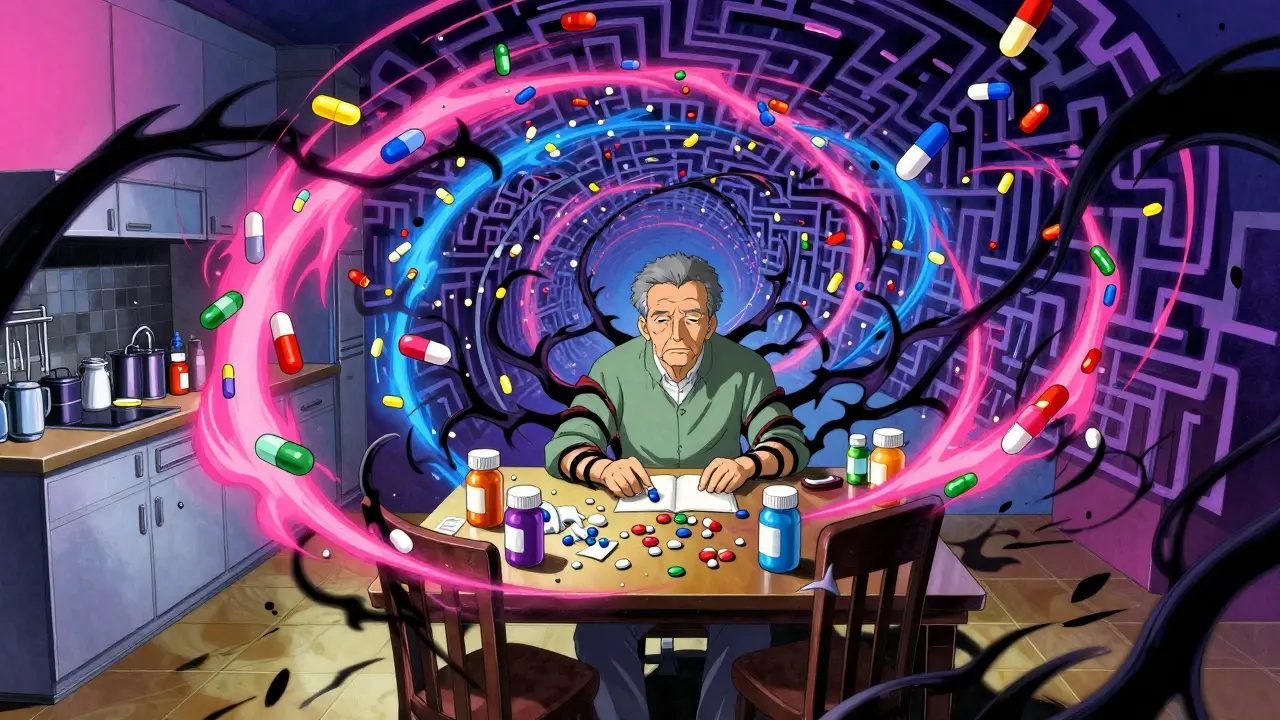
One of the biggest risks for older adults is polypharmacy-the use of multiple medications simultaneously. According to the CDC, 48% of adults aged 65 and older take five or more prescription medications monthly. Taking ten or more is common, affecting 21% of this demographic.
Each additional medication increases the chance of interactions exponentially. It’s not just about two drugs clashing; it’s about how five different drugs stress the liver and kidneys simultaneously. A 2022 study found that comprehensive medication reviews identified an average of 3.2 discrepancies per patient-meaning wrong doses, expired meds, or unnecessary prescriptions were sitting in medicine cabinets.
This complexity leads to adverse drug events (ADEs). The U.S. spends approximately $30 billion annually on preventable ADEs in older adults. That’s 15% of total medication costs for this group. These aren't just minor inconveniences; they lead to falls, fractures, confusion, and hospitalizations.
Red Flag Medications: The Beers Criteria
Not all drugs are created equal when it comes to aging. Some carry disproportionately high risks for little benefit. To help doctors navigate this, the American Geriatrics Society publishes the Beers Criteria. First introduced in 1991 and updated regularly (most recently in 2023), this list identifies medications that are potentially inappropriate for older adults.
The 2023 update flags 56 specific medications or classes. Here are some of the most common culprits and why they’re risky:
- Benzodiazepines (e.g., lorazepam, alprazolam): These anxiety and sleep aids increase the risk of falls and hip fractures by 2-3 times. They also cause significant cognitive decline and delirium.
- Anticholinergics (e.g., diphenhydramine/Benadryl, amitriptyline): Often used for allergies, sleep, or pain, these block acetylcholine, a neurotransmitter vital for memory. A University of Florida study found a 4.2 times higher incidence of delirium in patients over 75 taking these drugs.
- NSAIDs (e.g., ibuprofen, naproxen): Long-term use significantly raises the risk of stomach bleeding and kidney failure, which are already concerns in aging bodies.
- Opioids (e.g., oxycodone, hydrocodone): Higher risks of constipation, falls, and respiratory depression make these dangerous unless carefully monitored.
If you see any of these on your prescription list, ask your doctor: "Is this still necessary? Is there a safer alternative?"
Real-World Consequences: Falls, Confusion, and Hospitalization
The statistics come alive when you hear personal stories. On the AgingCare.com forum, a caregiver shared how her 82-year-old mother fractured her hip after falling due to orthostatic hypotension-a sudden drop in blood pressure upon standing-caused by a blood pressure medication dose meant for a 50-year-old.
Another user, 'ElderlyPatient92', described developing severe urinary retention requiring catheterization within three days of starting amitriptyline for nerve pain. This is a classic anticholinergic side effect that hits harder in older men with prostate issues.
A survey of 1,200 adults over 65 revealed that 68% experienced dizziness or falls related to meds, 54% reported confusion, and 41% had unintended weight changes. Nearly half (45%) admitted to stopping medications entirely because of side effects, with constipation, dizziness, and confusion being the top reasons. Stopping meds abruptly can be dangerous, so communication with healthcare providers is essential.

Action Plan: Protecting Yourself Through Smart Management
You have power in this equation. Here is how to manage medication safety effectively:
- Practice 'Brown Bag Reviews': Once a year, put all your medications-including over-the-counter drugs, vitamins, and supplements-into a brown paper bag. Bring this bag to your doctor or pharmacist. Ask them to review everything for interactions and necessity. This simple step catches hidden dangers.
- Embrace Deprescribing: Just as we prescribe new meds, we should actively stop ones that no longer provide benefit or pose too much risk. Dr. Michael Steinman, lead author of the Beers Criteria, emphasizes that goals of care evolve. If a statin isn’t preventing a heart attack but causing muscle pain, it might be time to stop. Discuss deprescribing with your doctor.
- Start Low, Go Slow: This is the golden rule of geriatric prescribing. Doctors should start at 25-50% of the standard adult dose and titrate up slowly. If your doctor prescribes a full adult dose, ask if a lower starting point is appropriate.
- Monitor Kidney Function: Ensure your doctor checks your estimated glomerular filtration rate (eGFR) regularly, not just serum creatinine. Dose adjustments are needed when eGFR drops below 60 mL/min/1.73m².
- Use Technology: Apps like the Beers Criteria mobile app can help clinicians check for inappropriate meds in real-time. Patients can use pill organizers with alarms to ensure consistency and avoid double-dosing.
The Future of Personalized Care
The field is moving toward precision medicine. Pharmacogenomic testing, which analyzes how your genes affect drug metabolism, is gaining traction. A 2023 study showed that testing for CYP2D6 and CYP2C19 enzymes reduced adverse drug reactions by 35% in older adults taking psychotropic medications. While not yet universal, asking about genetic testing for complex medication regimens is becoming a valid question.
Additionally, the FDA is pushing for more inclusion of patients over 75 in clinical trials, aiming for 25% representation by 2026. This will close the evidence gap that has long plagued geriatric prescribing. Until then, staying informed and advocating for yourself remains your strongest tool.
Why do older adults need lower doses of medication?
Older adults need lower doses because their bodies process drugs less efficiently. Kidney and liver function decline, meaning drugs stay in the system longer and reach higher concentrations. Additionally, changes in body composition (less water, more fat) alter how drugs are distributed. Starting with lower doses prevents toxicity and severe side effects.
What is the Beers Criteria?
The Beers Criteria is a widely recognized list of potentially inappropriate medications for older adults, published by the American Geriatrics Society. It identifies drugs that have higher risks of adverse effects relative to their benefits in this age group. Examples include benzodiazepines for insomnia and strong anticholinergics for allergies.
What is polypharmacy, and why is it dangerous?
Polypharmacy refers to taking multiple medications, typically defined as five or more. It is dangerous because each added drug increases the risk of interactions, side effects, and non-adherence. In older adults, whose organs are less resilient, polypharmacy is a leading cause of falls, confusion, and hospitalizations.
What is deprescribing?
Deprescribing is the planned and supervised process of tapering or stopping medications that may be causing harm or are no longer aligned with the patient's health goals. It aims to reduce side effects and improve quality of life without compromising necessary care.
How can I check if my medications are safe for my age?
You can request a 'Brown Bag Review' with your pharmacist or doctor, bringing all your prescriptions, OTC drugs, and supplements. Ask specifically if any medications appear on the Beers Criteria or STOPP/START criteria. Your provider can assess whether doses need adjustment based on your kidney and liver function.