
DOAC Safety Profile Comparator
Select Your Health Factors
Based on the article data, select the conditions that apply to you.
Risk Comparison Analysis
Relative Risk Scores (Lower is Better)
Apixaban
- ✓ Lowest GI bleed risk
- ✓ Safe for kidneys
- ✓ Safe for elderly
Rivaroxaban
- ⚠ Higher GI bleed risk
- ⚠ Higher major bleeding
- ✓ Once daily dosing
Dabigatran
- ✗ Poor with kidney issues
- ✗ Increased Heart Attack risk
- ⚠ GI irritation
Choosing a blood thinner is never just about preventing clots. It’s about balancing that protection against the risk of bleeding and other side effects. For years, warfarin was the standard, but it required constant monitoring and dietary restrictions. Today, Direct Oral Anticoagulants (DOACs) have largely taken over. But here is the catch: they are not all the same.
If your doctor prescribes apixaban, rivaroxaban, or dabigatran, you might assume they work identically with identical risks. They don’t. While all three prevent strokes and blood clots effectively, their side effect profiles differ significantly. Understanding these differences can help you have a more informed conversation with your healthcare provider and potentially choose the medication that fits your specific health history best.
How These Blood Thinners Work Differently
To understand why the side effects vary, you first need to look at how these drugs interact with your body. They are called "direct" oral anticoagulants because they target specific proteins in the coagulation cascade without needing regular blood tests like warfarin does.
Dabigatran (brand name Pradaxa) works by directly inhibiting thrombin, also known as Factor IIa. Thrombin is the enzyme that converts fibrinogen into fibrin, which forms the mesh of a blood clot. By blocking this step, dabigatran stops clots from forming.
Rivaroxaban (Xarelto) and apixaban (Eliquis) take a different approach. They are Factor Xa inhibitors. Factor Xa is an earlier step in the cascade that activates thrombin. By blocking Factor Xa, these drugs reduce the amount of thrombin available to form clots. Even though rivaroxaban and apixaban target the same factor, their chemical structures and binding characteristics differ, leading to distinct safety profiles.
| Feature | Apixaban (Eliquis) | Rivaroxaban (Xarelto) | Dabigatran (Pradaxa) |
|---|---|---|---|
| Target Mechanism | Factor Xa Inhibitor | Factor Xa Inhibitor | Direct Thrombin Inhibitor |
| Half-Life | 8-15 hours | 5-13 hours | 12-17 hours |
| Renal Excretion | ~25% | ~33% | ~80% |
| Dosing Frequency | Twice daily | Once or twice daily* | Twice daily |
| Kidney Disease Limit | CrCl <15 mL/min | CrCl <15 mL/min | CrCl <30 mL/min (150mg dose) |
*Rivaroxaban is dosed once daily for stroke prevention in atrial fibrillation but twice daily for treating venous thromboembolism (blood clots in legs/lungs).
The Gastrointestinal Bleeding Divide
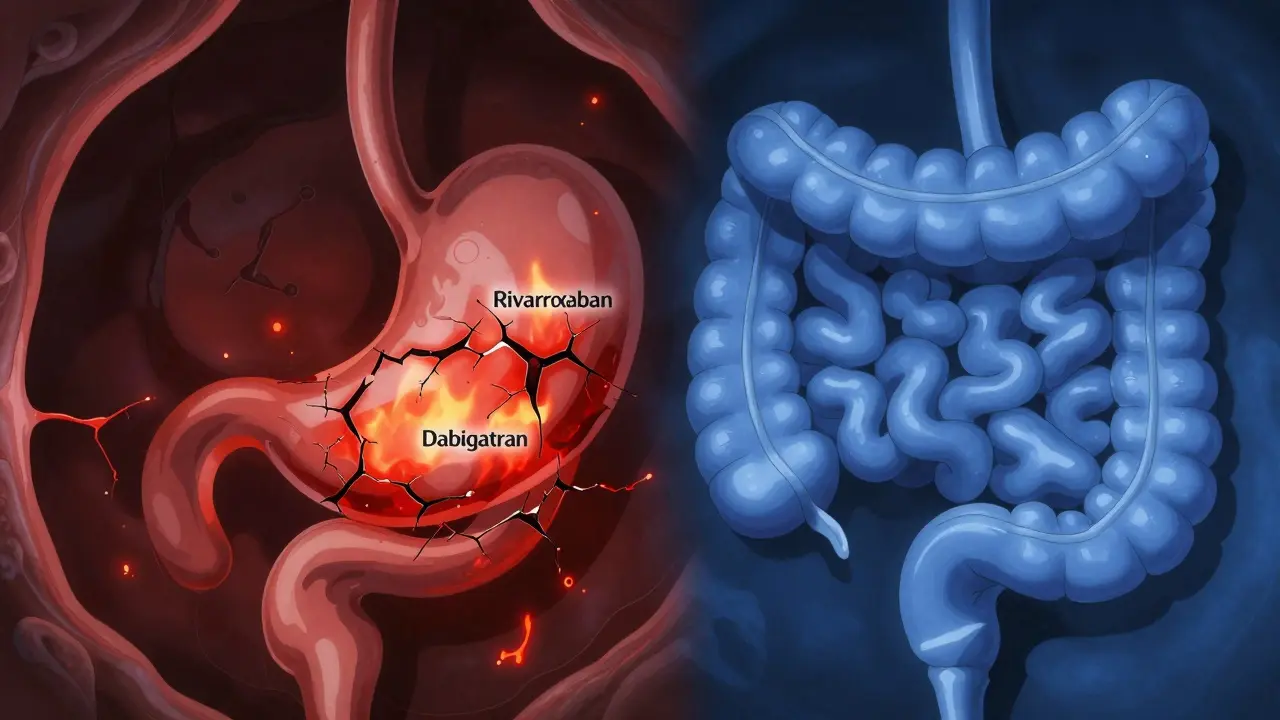
If there is one area where these drugs separate clearly, it is gastrointestinal (GI) bleeding. This includes bleeding from the stomach, intestines, or esophagus. It can range from minor issues like black, tarry stools to severe, life-threatening hemorrhages requiring hospitalization.
Data consistently shows that apixaban has the lowest risk of GI bleeding among the three. A major study published in JAMA Network in 2022 compared real-world outcomes and found stark differences. Rivaroxaban showed 35.2 GI bleeds per 1,000 person-years, while apixaban had only 16.3. That means patients on rivaroxaban were roughly twice as likely to experience GI bleeding compared to those on apixaban.
Dabigatran also carries a higher risk than apixaban. The same Oxford Academic study noted event rates of 3.22 per 100 person-years for dabigatran versus 2.17 for apixaban. If you have a history of peptic ulcers, gastritis, or if you regularly take NSAIDs (like ibuprofen or naproxen), this difference matters. The American College of Cardiology explicitly notes that for patients with high GI bleeding risk, apixaban may be preferred over rivaroxaban or dabigatran.
Why does this happen? Rivaroxaban is often taken with food to improve absorption, and its direct contact with the gastric mucosa might irritate the stomach lining more than the other agents. Dabigatran comes in capsules containing tartaric acid, which can cause dyspepsia (indigestion) and contribute to GI irritation.
Bleeding Risks Beyond the Gut
GI bleeding isn't the only concern. Major extracranial bleeding-bleeding in areas outside the brain, such as muscles, joints, or surgical sites-also varies.
Rivaroxaban tends to show higher rates of major bleeding overall. The JAMA Network study highlighted that rivaroxaban had 39.7 major extracranial bleeds per 1,000 person-years, compared to just 18.5 for apixaban. This nearly doubles the relative risk.
Intracranial hemorrhage (bleeding in the brain) is the most feared complication of any anticoagulant. Fortunately, all three DOACs are significantly safer than warfarin in this regard. However, subtle differences exist. Some studies, including a head-to-head analysis in PubMed 2022, suggested rivaroxaban might have a slightly lower rate of intracranial hemorrhage compared to apixaban. Conversely, older analyses indicated dabigatran (especially the lower 110 mg dose) offered strong protection against brain bleeds. Despite these nuances, the absolute risk remains low for all three, making them far superior to older therapies for preventing stroke-related brain damage.
The Heart Risk: Dabigatran and Myocardial Infarction
This is perhaps the most surprising difference. You might think a blood thinner would protect your heart, but data suggests dabigatran may carry a unique cardiac risk.
Multiple meta-analyses, including research cited in PMC 2014 and JACC 2012, have documented an increased risk of myocardial infarction (heart attack) or acute coronary syndrome (ACS) with dabigatran use. One analysis reported a statistically significant 48% relative increase in MI events with dabigatran compared to controls. Another found a greater than 50% increase compared to rivaroxaban.
The mechanism isn't fully understood, but experts hypothesize that directly inhibiting thrombin might trigger pro-inflammatory effects similar to ximelagatan, an earlier drug that was withdrawn from the market due to liver toxicity and inflammation. Thrombin plays roles beyond clotting, including cell growth and inflammation. Blocking it completely might inadvertently promote plaque instability in arteries.
If you have existing coronary artery disease or a history of heart attacks, this signal is critical. Your cardiologist might lean toward apixaban or rivaroxaban to avoid this potential added risk.
Kidney Function and Drug Clearance
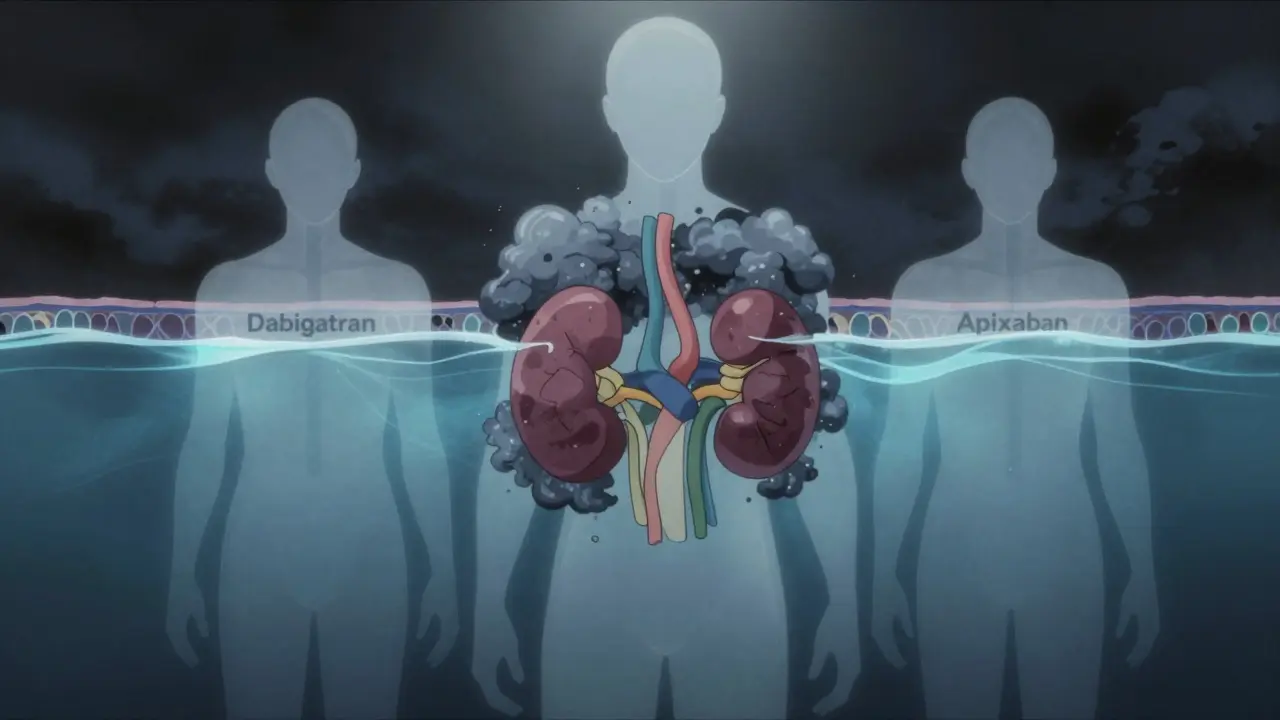
Your kidneys play a huge role in clearing these drugs from your body. If your kidneys aren't working well, the drug builds up, increasing the risk of bleeding.
Dabigatran relies heavily on renal excretion-about 80% of the drug leaves through the urine. This makes it the most sensitive to kidney impairment. The FDA labeling contraindicates the standard 150 mg dose if your creatinine clearance (CrCl) is below 30 mL/min. Apixaban and rivaroxaban are much friendlier to failing kidneys, with only 25% and 33% renal excretion, respectively. Both are generally safe until CrCl drops below 15 mL/min.
This pharmacokinetic difference is why dabigatran usage has declined in patients with chronic kidney disease (CKD). Apixaban has become the go-to choice for elderly patients or those with moderate renal impairment because it maintains efficacy while minimizing accumulation and bleeding risk.
Mortality and Overall Safety
When looking at total mortality, the picture becomes complex. A 2022 JAMA Network study adjusted for various factors and found that rivaroxaban was associated with higher total mortality (44.2 per 1,000 person-years) compared to apixaban (41.0 per 1,000 person-years). This included a higher risk of fatal ischemic or hemorrhagic events.
However, efficacy in preventing strokes remains comparable across all three. The Oxford Academic study showed similar stroke/systemic embolism rates for dabigatran, rivaroxaban, and apixaban. So, while they all do the primary job of stopping strokes equally well, the "cost" in terms of bleeding and other adverse events differs.
Which One Is Right for You?
There is no single "best" DOAC for everyone. The choice depends on your individual risk profile:
- High GI Bleeding Risk: If you have a history of ulcers, gastritis, or take aspirin/NSAIDs regularly, apixaban is often the preferred choice due to its superior GI safety profile.
- Kidney Issues: If you have mild to moderate kidney disease, apixaban or rivaroxaban are safer bets than dabigatran. Severe CKD requires careful specialist management regardless of the drug.
- Coronary Artery Disease: If you have a history of heart attacks, avoiding dabigatran might be prudent due to the observed MI risk signals.
- Adherence Concerns: Rivaroxaban offers once-daily dosing for atrial fibrillation, which helps people who struggle to remember two pills a day. However, this convenience comes with higher bleeding risks.
Market trends reflect these clinical insights. IQVIA data from 2023 shows apixaban captured approximately 45% of the US DOAC market, becoming the most prescribed option. Rivaroxaban holds about 35%, while dabigatran has fallen to around 10%, likely due to the combination of GI bleeding concerns, renal limitations, and cardiac risk signals.
Generic versions of all three are now available, significantly reducing costs. Brand-name Eliquis can cost hundreds of dollars, but generics make these essential medications accessible. Always check with your pharmacist about generic availability and insurance coverage.
Can I switch from one DOAC to another?
Yes, switching is common, but it must be done under medical supervision. Because these drugs have different half-lives and mechanisms, your doctor needs to calculate the exact timing to ensure you are never unprotected against clots or overdosed on anticoagulation. Never stop or switch on your own.
Do I need regular blood tests with these medications?
Unlike warfarin, DOACs do not require routine INR monitoring. However, your doctor should still check your kidney function (creatinine levels) annually or more frequently if you have kidney disease, as impaired kidneys can lead to dangerous drug buildup.
What should I do if I miss a dose?
If you miss a dose, take it as soon as you remember on the same day. Do not double up on doses to make up for a missed one. If it is already time for your next dose, skip the missed one and continue with your regular schedule. Consistency is key to maintaining steady protection.
Is apixaban safer than rivaroxaban for elderly patients?
Evidence suggests yes. Studies, including those in Annals of Internal Medicine, confirm that apixaban's advantage in reducing gastrointestinal bleeding persists in patients over 80 years old. Since elderly patients are at higher baseline risk for falls and GI issues, this safety margin is clinically significant.
Are there reversal agents for these drugs?
Yes. Idarucizumab (Praxbind) reverses dabigatran. Andexanet alfa (Andexxa) reverses factor Xa inhibitors like apixaban and rivaroxaban. These are expensive emergency treatments used in cases of life-threatening bleeding or before urgent surgery, so always inform surgeons and dentists about your medication.