Medication Label Clarity & Safety Simulator
Select a common medication instruction scenario below to see how different labeling strategies impact patient understanding and safety.
Safety Impact Analysis
Click on any label card above to analyze its effectiveness based on health literacy research.
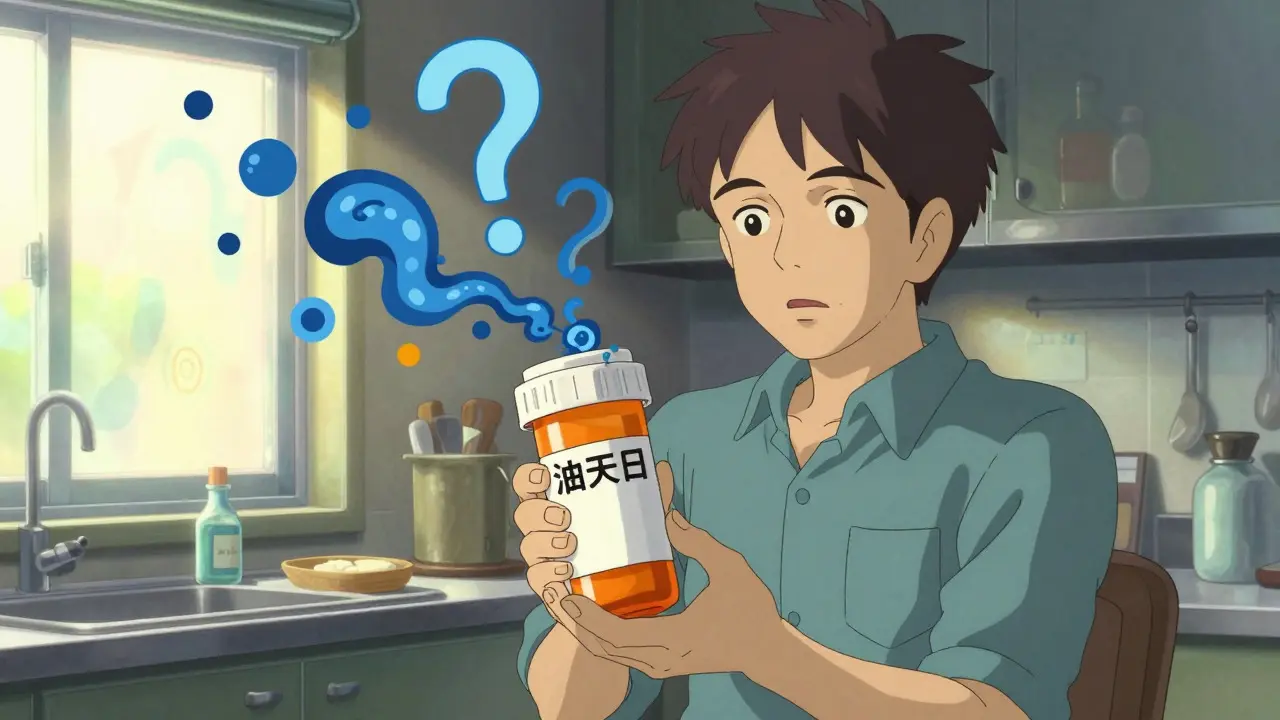
Imagine standing in your kitchen, holding a small orange bottle. The label says 'Take 1 tablet by mouth twice daily.' You nod, put it down, and go about your day. But later, you wonder: does 'twice daily' mean every twelve hours? Or just morning and night? Does it matter if I eat first? This moment of uncertainty is more common than you might think, and it’s exactly where health literacy strategies step in to bridge the gap between complex medical instructions and real-life understanding.
Poor comprehension of medication labels isn’t just an inconvenience; it’s a significant safety risk. Research from the Institute of Medicine highlights that low health literacy is a root cause of medication errors, poor adherence, and worse health outcomes. In fact, studies show that nearly half of adults misinterpret at least one aspect of their medication instructions. When we fail to understand how to take our medicine correctly, we risk everything from mild side effects to serious hospitalizations. The good news? There are proven, practical strategies-both for patients and providers-to make these labels clear, safe, and actionable.
The Hidden Complexity of Standard Labels
We often assume that if a label is written in English, we should understand it. But standard prescription labels are frequently written at a tenth-grade reading level, while the average adult has a sixth- to eighth-grade health literacy level. This mismatch creates a dangerous blind spot. For example, instructions like 'take every 4-6 hours as needed' can be interpreted wildly differently. One study found that some patients read this as 'take 4 to 6 tablets,' leading to accidental overdoses.
Consider the difference between 'Take 1 tablet by mouth twice daily' and 'Take 1 tablet by mouth in the morning and 1 tablet by mouth in the evening.' The latter is explicit. A pivotal 2009 study published in the *Journal of General Internal Medicine* demonstrated that switching to explicit language improved patient comprehension by 15-20% across all literacy levels. Yet, even with better wording, patients with limited literacy remained 2.3 times more likely to misinterpret instructions. This tells us that while clearer words help, they aren't a silver bullet on their own.
Another major issue is the confusion between units of measurement. Mixing up milligrams (mg) and milliliters (ml) is a classic error, especially with liquid medications. Parents administering medicine to children face unique challenges here. A review of top-selling oral liquid nonprescription medications found that 63% used chart-form dosing instructions that confused parents with low health literacy. In contrast, only 8% used pictographic forms, which significantly improved comprehension. These details matter because a small miscalculation in pediatric dosing can have immediate consequences.
Visual Cues and Pictograms: Seeing Is Understanding
Words alone often fall short. That’s why visual elements have become a cornerstone of modern health literacy strategies. Pictograms-simple icons representing actions like taking a pill with water or storing medicine in a cool place-can cut through language barriers and cognitive overload.
Research supports this approach strongly. Labels incorporating pictograms increased correct interpretation by 28% among patients with limited health literacy. The U.S. Pharmacopeia (USP) recognized this value when it updated its General Chapter <17> on design principles for medication labels in May 2023. This update mandates specific formatting requirements, including the use of clear visuals, with full compliance required by May 2025. It’s a regulatory push toward making labels universally understandable, not just legally compliant.
Think about it: an icon of a sun means 'morning,' and an icon of a moon means 'bedtime.' No vocabulary test required. For elderly patients or those whose first language isn’t English, these symbols provide a reliable anchor. However, visuals must be standardized. If one pharmacy uses a cup icon for 'take with food' and another uses a plate, the confusion returns. Consistency is key to building trust and accuracy.
The Universal Medication Schedule (UMS)
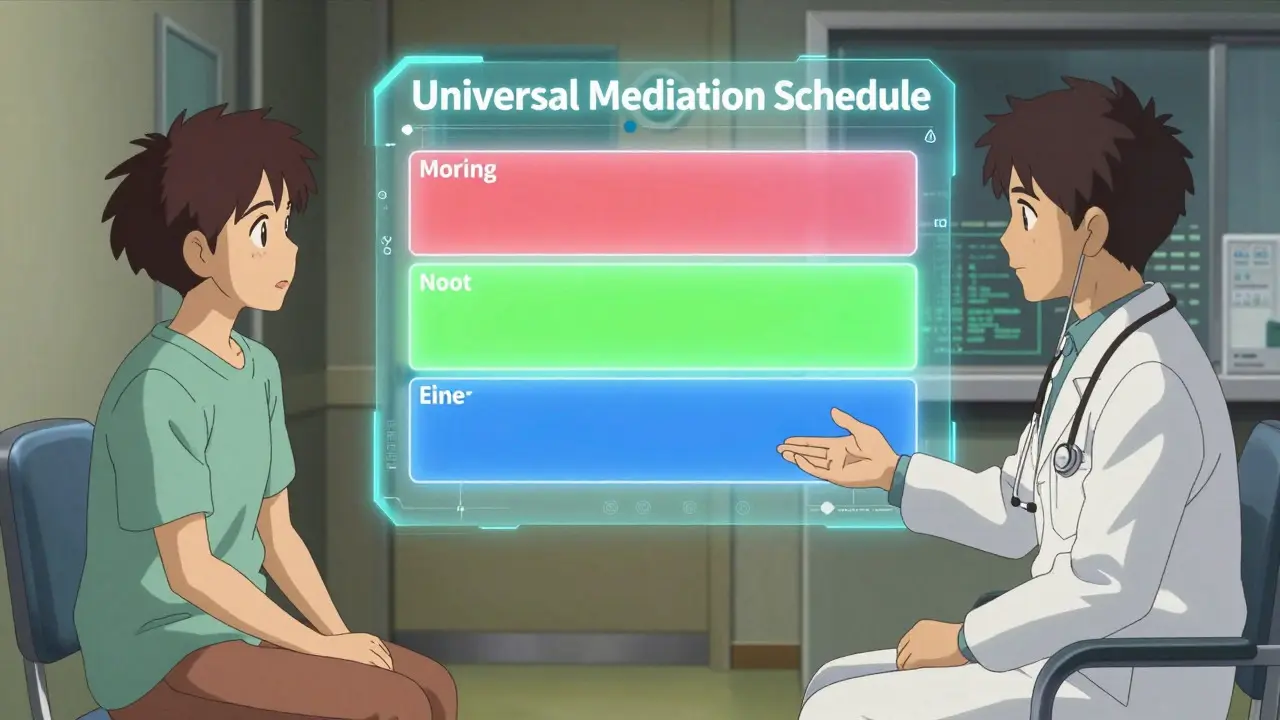
One of the most effective structural changes in medication management is the adoption of the Universal Medication Schedule (UMS). Instead of vague terms like 'three times a day,' UMS standardizes timing to four distinct intervals: morning, noon, evening, and bedtime. This simplification reduces the mental math required to figure out when to take pills.
The impact of UMS is measurable. Wisconsin Health Literacy’s 2022 implementation toolkit documented that health systems adopting UMS reduced dosing confusion by 47% among elderly patients taking multiple medications. Imagine a 72-year-old patient managing blood pressure, diabetes, and cholesterol. With traditional labels, they might struggle to align different regimens. With UMS, each drug is assigned to a simple time slot. One patient shared, "I finally understood when to take my pills after they switched to morning/noon/evening/bedtime labels." That clarity translates directly into better health outcomes.
Implementing UMS requires coordination across pharmacy, physician, and nursing teams. It involves modifying electronic health record systems and training staff, typically taking 12-16 weeks and 80-120 staff hours for a health system. While there was initial resistance from some clinicians who worried about the extra time, data showed a 22% decrease in medication-related readmissions within six months. That return on investment speaks volumes.

Patient-Centered Labels and Communication Bundles
Beyond scheduling, the way information is presented matters immensely. Patient-centered labels focus on what the patient needs to do, rather than what the doctor prescribed. They use active voice, short sentences, and plain language. For instance, instead of 'Administer orally,' a patient-centered label says 'Swallow whole.'
A 2013 study in the *Annals of Internal Medicine* evaluated patient-centered labels and found a 32% reduction in participants exceeding the maximum dose in 24 hours compared to standard labels. This is a critical safety metric. Preventing overdose is often more urgent than ensuring perfect timing. However, the same study noted that patient-centered labels didn’t significantly reduce other errors, like taking too many pills at once. This suggests that labeling is part of the solution, but not the whole picture.
This is where communication bundles come in. These are structured interactions between healthcare providers and patients designed to reinforce understanding. A 2023 randomized clinical trial at Children's Hospital of Philadelphia tested a brief, low-resource health literacy-informed discharge communication bundle. The results were striking: it reduced liquid medication dosing errors by 34% compared to standard counseling. Caregivers also demonstrated 22% higher medication knowledge scores. The bundle included simple steps: checking literacy levels, using teach-back methods, and providing visual aids.
The Teach-Back Method: Closing the Loop
You’ve probably heard of 'teach-back,' but let’s clarify why it’s so powerful. It’s not about testing the patient; it’s about testing your own explanation. After giving instructions, you ask the patient to repeat them back in their own words. If they say, "I’ll take two pills in the morning," and you meant one, you catch the error immediately.
The teach-back method adds only 1-2 minutes per medication but reduces misunderstanding rates by 33%, according to UW Health implementation data. It shifts the dynamic from passive listening to active engagement. Patients feel empowered, and providers gain confidence that the message landed. It’s a simple tool with profound effects, yet it’s underutilized in busy clinics. Why? Often because providers fear offending patients by implying they didn’t listen. Reframing it as 'Let me make sure I explained this clearly' removes that stigma.
Assessment Tools and Personalized Support
Not every patient needs the same level of support. Identifying who does is crucial. Assessment tools like the Test of Functional Health Literacy in Adults (TOFHLA) and the Rapid Estimate of Adult Literacy in Medicine (REALM) help identify patients who need additional assistance. The REALM-SF (Short Form) takes just 2-3 minutes to administer, making it feasible in fast-paced settings.
| Tool Name | Time Required | Best Use Case |
|---|---|---|
| TOFHLA | 7-12 minutes | Comprehensive assessment in specialized clinics |
| REALM-SF | 2-3 minutes | Quick screening in primary care or emergency departments |
| Teach-Back | 1-2 minutes per med | Verifying understanding during any consultation |
Once identified, patients can receive materials tailored to their needs. This might mean large-print labels, translations in their preferred language, or audio instructions. The goal is equity: ensuring that someone with a college degree and someone who dropped out of high school both leave the pharmacy with the same level of confidence in how to take their medicine.
Challenges and Future Directions
Despite the evidence, widespread adoption faces hurdles. Time is the biggest constraint. Adding 2-3 minutes to every patient encounter feels impossible in high-volume practices. Then there’s the cost. Rural clinics report having 40% fewer resources for health literacy initiatives compared to urban academic centers. And while CMS links medication adherence to reimbursement, hospitals still face penalties for readmissions, creating a reactive rather than proactive culture.
Yet, the tide is turning. The global health literacy solutions market, valued at $3.2 billion in 2022, is projected to grow at 14.7% annually through 2030. Medication labeling solutions comprise 38% of this market. New technologies are emerging too. Merck is developing an AI-powered label comprehension assessment tool expected in Q2 2024, which could automate the identification of confusing instructions. The FDA is also planning to require standardized pictograms on all prescription labels, further driving consistency.
Ultimately, health literacy isn’t just about smarter patients; it’s about smarter systems. It’s about designing labels, schedules, and conversations that work for everyone, regardless of background or education. When we get this right, we don’t just prevent errors-we build trust. And in healthcare, trust is the foundation of safety.
What is the Universal Medication Schedule (UMS)?
The Universal Medication Schedule (UMS) is a standardized system that groups medication doses into four fixed daily times: morning, noon, evening, and bedtime. This simplifies scheduling for patients taking multiple medications, reducing confusion and errors by eliminating complex timing instructions like 'every 8 hours.'
How does the teach-back method improve medication safety?
The teach-back method asks patients to repeat medication instructions in their own words. This allows providers to immediately correct misunderstandings. Studies show it reduces misunderstanding rates by 33% and takes only 1-2 minutes per medication, making it a highly efficient safety check.
Why are pictograms important on medication labels?
Pictograms provide visual cues that transcend language barriers and reading levels. Research shows that labels with pictograms increase correct interpretation by 28% among patients with limited health literacy. They help clarify actions like taking medicine with food or storing it properly.
What is the difference between mg and ml, and why does it matter?
Milligrams (mg) measure weight, typically used for solid pills. Milliliters (ml) measure volume, used for liquids. Confusing the two can lead to dangerous overdoses or underdoses, especially in pediatric care. Clear labeling and visual aids are essential to prevent this common error.
Are patient-centered labels better than standard labels?
Yes, patient-centered labels use plain language and active voice, which improves comprehension. A study found they reduced maximum dose exceedance by 32% compared to standard labels. However, they work best when combined with other strategies like teach-back and visual aids.
How long does it take to implement health literacy strategies in a clinic?
Implementing comprehensive strategies like the Universal Medication Schedule can take 12-16 weeks and require 80-120 staff hours for training and system updates. However, simpler tactics like teach-back can be adopted immediately with minimal time investment.